
What 1,000 AI agent operations cost by model (November 2026)
Nine widely used tool-calling models, public list prices retrieved on November 23, 2026, explicit token assumptions and one formula you can rerun with your own numbers.
Authors Qaalia Team ·
Short answer: with list prices published by OpenRouter on November 23, 2026, and an operation defined as two model calls totaling 12,000 input tokens and 500 output tokens, 1,000 agent operations cost from $0.70 (DeepSeek V4.1 Flash) to $58 (GPT-5.6 Sol). Claude Sonnet 5.5 comes to $29, Gemini 3.8 Flash to about $12 and Claude Haiku 5.5 to $1.45. Input tokens, mostly the system prompt and tool definitions repeated on every call, are most of the bill, which is why prompt caching and batching move the number more than switching between similar models.
Every price in this post comes from OpenRouter's public models endpoint (openrouter.ai/api/v1/models), retrieved on November 23, 2026 at 13:39 UTC. No benchmark or quality score is implied: this is arithmetic on list prices. The raw numbers are in a CSV file so you can check them.
What counts as one agent operation?
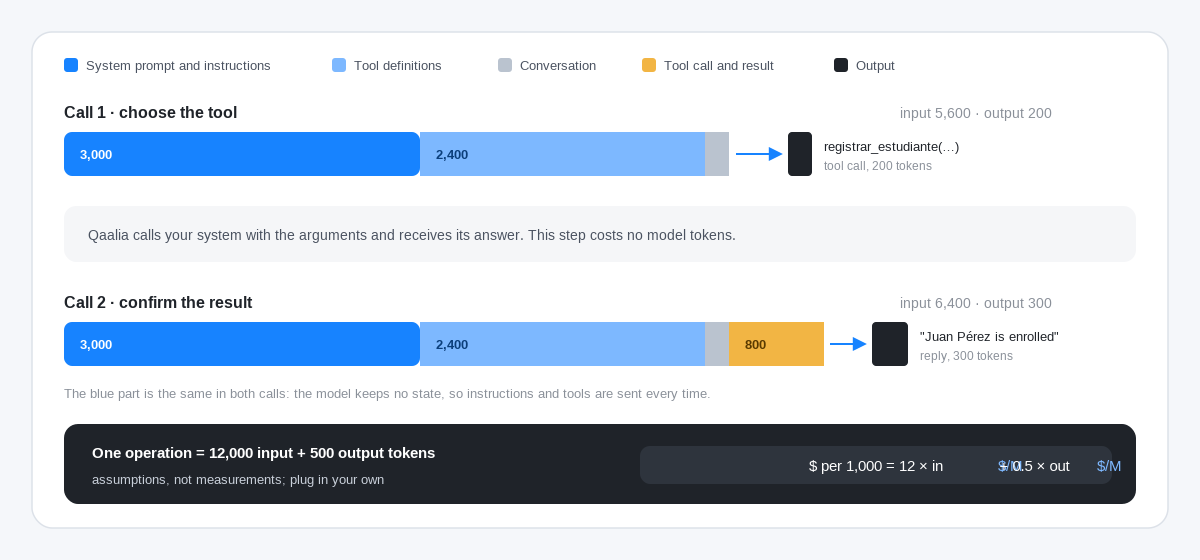
An operation here is one business action requested in plain words, such as "register Juan Pérez in Chemistry", where the agent calls one tool and confirms the result. That takes two model calls: one to read the request and choose the tool, and one to read the tool's answer and reply. Both calls resend the same instructions and tool definitions, because the model keeps no state between calls.
| Part of the request | Call 1: choose the tool | Call 2: confirm the result |
|---|---|---|
| System prompt, business context and agent instructions | 3,000 | 3,000 |
| Tool definitions (about 12 operations with their parameters) | 2,400 | 2,400 |
| Recent conversation and the user's message | 200 | 200 |
| The tool call and your system's answer | 0 | 800 |
| Totals per operation | ||
| Input tokens | 5,600 | 6,400 |
| Output tokens (tool call, then the reply) | 200 | 300 |
That adds up to 12,000 input tokens and 500 output tokens per operation. These are assumptions, not measurements of any product: a lean agent with three tools might send half as much, and an agent with a long knowledge base in its prompt might send five times more. The formula below lets you plug in your own numbers.
How do you calculate the cost of 1,000 operations?
Model prices are quoted in US dollars per million tokens, separately for input and output. For 1,000 operations:
cost = 1,000 × (input_tokens × input_price + output_tokens × output_price) / 1,000,000

with 12,000 input and 500 output tokens per operation:
cost = 12 × input_price + 0.5 × output_price
For Claude Sonnet 5.5, listed at $2 per million input tokens and $10 per million output tokens: 12 × 2 + 0.5 × 10 = 24 + 5 = $29 per 1,000 operations, or 2.9 cents each. Note that $24 of the $29 is input.
How much do 1,000 operations cost on each model?
We chose nine widely used models that support tool calling on OpenRouter: the current flagship and a smaller tier from Anthropic, OpenAI and Google, plus Qwen, Kimi and DeepSeek. Prices are OpenRouter's listed prices for prompts under 100,000 tokens; some models charge more above a threshold, which a 6,400-token call never reaches.
| GPT-5.6 Sol | 58.00 |
|---|---|
| Gemini 3.1 Pro (Preview) | 30.00 |
| Claude Sonnet 5.5 | 29.00 |
| Qwen3.8 Max | 27.00 |
| Gemini 3.8 Flash | 11.96 |
| Kimi K3.1 Pro | 7.08 |
| GPT-5.6 Luna | 3.00 |
| Claude Haiku 5.5 | 1.45 |
| DeepSeek V4.1 Flash | 0.70 |
Source: OpenRouter models API, retrieved November 23, 2026, 13:39 UTC; 12,000 input and 500 output tokens per operation. Download the CSV.
| Model (OpenRouter ID) | Input $/M | Output $/M | Cost per 1,000 operations | Per operation |
|---|---|---|---|---|
| Flagship and large models | ||||
GPT-5.6 Sol (openai/gpt-5.6-sol) | $4.00 | $20.00 | $58.00 | 5.8¢ |
Gemini 3.1 Pro Preview (google/gemini-3.1-pro-preview) | $2.00 | $12.00 | $30.00 | 3.0¢ |
Claude Sonnet 5.5 (anthropic/claude-sonnet-5.5) | $2.00 | $10.00 | $29.00 | 2.9¢ |
Qwen3.8 Max (qwen/qwen3.8-max-0902) | $2.00 | $6.00 | $27.00 | 2.7¢ |
Kimi K3.1 Pro (moonshotai/kimi-k3.1-pro) | $0.24 | $8.40 | $7.08 | 0.71¢ |
| Fast and small models | ||||
Gemini 3.8 Flash (google/gemini-3.8-flash) | $0.825 | $4.125 | $11.96 | 1.2¢ |
GPT-5.6 Luna (openai/gpt-5.6-luna) | $0.20 | $1.20 | $3.00 | 0.30¢ |
Claude Haiku 5.5 (anthropic/claude-haiku-5.5) | $0.10 | $0.50 | $1.45 | 0.15¢ |
DeepSeek V4.1 Flash (deepseek/deepseek-v4.1-flash) | $0.0498 | $0.1992 | $0.70 | 0.07¢ |
Two things stand out. The spread is about 80 to 1 between the most and least expensive model for the same work. And output price barely matters for this kind of operation: Kimi K3.1 Pro has a higher output price than Qwen3.8 Max but costs about a quarter as much here, because its input price is about an eighth.
How do reasoning tokens change the bill?
Reasoning models think before they answer, and providers bill those thinking tokens as output. If each operation adds 2,000 reasoning tokens across its two calls, the formula gains 2 × output_price per 1,000 operations:
| Model | No reasoning | +2,000 reasoning tokens per operation | Increase |
|---|---|---|---|
| GPT-5.6 Sol | $58.00 | $98.00 | +69% |
| Gemini 3.1 Pro Preview | $30.00 | $54.00 | +80% |
| Claude Sonnet 5.5 | $29.00 | $49.00 | +69% |
| Qwen3.8 Max | $27.00 | $39.00 | +44% |
| Kimi K3.1 Pro | $7.08 | $23.89 | +237% |
| Gemini 3.8 Flash | $11.96 | $20.21 | +69% |
| GPT-5.6 Luna | $3.00 | $5.40 | +80% |
| Claude Haiku 5.5 | $1.45 | $2.45 | +69% |
| DeepSeek V4.1 Flash | $0.70 | $1.10 | +57% |
This is where the ranking can flip. A model with cheap input and expensive output, such as Kimi K3.1 Pro, is a bargain for short tool calls and much less so when it reasons at length. For routine operations, a low reasoning effort is usually enough; keep high effort for planning steps.
How much can prompt caching save?
The instructions and tool definitions are identical on every call, so providers that support prompt caching bill them at a lower "cache read" price after the first call. If 10,000 of the 12,000 input tokens of each operation are read from the cache, the formula becomes 10 × cache_read_price + 2 × input_price + 0.5 × output_price. With OpenRouter's listed cache-read prices, and ignoring the one-time cost of writing the cache:
- Claude Sonnet 5.5: cache reads at $0.10 per million, so $29.00 falls to $10.00.
- GPT-5.6 Sol: cache reads at $0.40 per million, so $58.00 falls to $22.00.
- Gemini 3.8 Flash: cache reads at $0.0825 per million, so $11.96 falls to $4.54.
- Kimi K3.1 Pro: cache reads at $0.20 per million, close to its input price, so $7.08 only falls to $6.68.
Whether you get those prices depends on the provider's cache rules (minimum prefix length, how long the cache lives and whether writes cost extra), so treat these as upper bounds on the saving. The full set of scenarios for every model is in the CSV.
Does a bulk job of 1,000 rows cost the same as 1,000 operations?
It should not. If an agent registers 1,000 students from a spreadsheet by emitting one tool call per student, you pay for every round trip and the context grows with each result. Qaalia avoids that by having the model declare the whole job once with an internal batch tool; the platform then sends the rows to your system itself and returns only a summary. The model is called at the start and at the end, not per row, and batch rows do not count as model rounds in Qaalia's durable tasks. How an AI agent runs thousands of operations without duplicates explains the mechanism.
As an illustration, assume the whole batch takes 3 model calls of 8,000 input and 500 output tokens each (24,000 and 1,500 in total). On Claude Sonnet 5.5 that is 0.024 × 2 + 0.0015 × 10 ≈ $0.06 for all 1,000 rows, against $29 for 1,000 separate operations. The assumption is ours and your numbers will differ, but the shape will not: the model cost of a batch is flat, not proportional to the number of rows.
Who pays for the tokens when you use Qaalia?
You pay your model provider directly. Today every Qaalia agent runs on a model you connect with your own API key (BYOK): an agent without a connected model returns an error instead of falling back to a model paid by Qaalia. Qaalia accepts keys from OpenRouter, OpenAI, Anthropic, Google Gemini, xAI, DeepSeek, Moonshot (Kimi), Alibaba Cloud (Qwen), Mistral and Groq, plus any OpenAI-compatible API at a public HTTPS address.
- No token markup. Your provider bills you at its own price, under your own limits and agreements; Qaalia does not resell tokens or charge for them.
- What the subscription covers. The platform: memory, tools, documents, long tasks, triggers and MCP. Messages are unlimited; what a plan counts is executions against your systems, each real call once, never twice for a retry.
- The key stays secret. It is stored in Supabase Vault, is only sent to the provider address it was saved with, and never reaches the model or the logs.
- You can check the real numbers. Qaalia's logs show the input and output tokens of each model call, so you can replace our assumptions with your own.
The prices in this post are OpenRouter's listings; buying directly from a provider can cost a little more or less. The point of the exercise is the method: count your real tokens per operation, apply the formula, and decide whether caching, a smaller model for routine steps or batching saves more. For a comparison of how other platforms handle model keys, see BYOK AI agent platforms compared.